1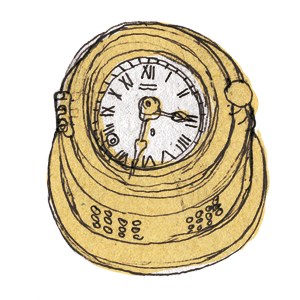
Punctual attraction
Clocks are commonly known to indicate time. But at sea a chronometer had another use. With their help it was possible to determine the longitude and thus the exact position of the ship – but only if the ship’s clock kept good time. The tower of the Kaiserspeicher in Hamburg, a widely visible landmark of the city, therefore housed a so-called time ball. Every day at 11.50 it was pulled up and exactly at noon it dropped down three meters. The captain on his ship was able to set the clock to Hamburg time and afterwards start his journey. The ball was regulated by the observatory at Millerntor via a subterranean wire connection until in 1934 radio signals took over the time check. A number of historical views of Hamburg show the storehouse and its unusual clock – today the new Elbphilharmonie occupies this site.