4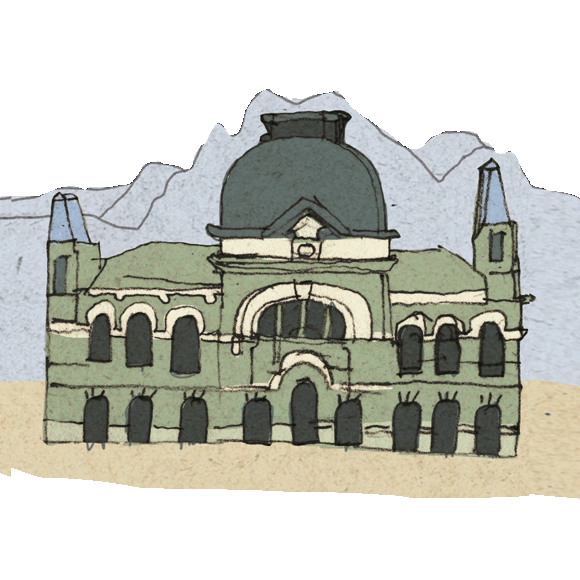
Megalomania on the Pilgrim’s Way
After the discovery of St. James’s tomb, the site quickly became a pilgrimage destination. The Iberian Peninsula finally had an apostle’s tomb, almost comparable to the tombs of Peter and Paul in Rome. And the Asturian kings, who owned Galicia, fought for their empire and faith under the saint’s banner, attracting streams of pilgrims from whom they profited handsomely. By the 10th century at the latest, people from all over Europe began to flock to Santiago, following routes that spread across the continent like a network. In France, these routes converged on four paths; three of them joined shortly before the Pyrenees and crossed the mountains at Roncesvalles. The fourth came from Occitania and led to the Somport Pass at an altitude of 1,600 meters; a pass that had already been used by the Celts and Romans.
On the Spanish side, just below the pass near Canfranc, a pilgrims’ hospital had stood since the 11th century, allegedly founded by King Sancho Ramírez. Nine hundred years later, in July 1928, one of his successors, King Alfonso XIII, together with the French president, inaugurated the railway line from Pau to Zaragoza, which ran through an eight-kilometer-long tunnel. Due to the different track gauges, passengers had to change trains in Canfranc. Whether the hope was to attract an international clientele or to offer passengers a pleasant atmosphere during passport control and transfer, the new station was a building of gigantic proportions, a wild mix of Neoclassical and Art Nouveau styles, with an integrated hotel, restaurants, and offices for the railway, police, and customs. No expense had been spared, but one thing hadn’t been considered: that it wouldn’t work. Passengers found the transfers and waiting times inconvenient. During the Spanish Civil War and in the aftermath of World War II, train service was suspended, and when a railway accident on the French side caused a bridge to collapse in 1970, the connection was never revived.
At least in 2023, the station building reopened as a luxury hotel, complete with all the bells and whistles. And if all goes well, the train will once again run through the tunnel from 2032 onwards.